Good Comics Out August 24: Goodbye, DCU
- Posted by Johanna on August 24, 2011 at 11:40 am
- Category: Shopping Guide
Looking back at when I’ve managed to do this supposedly-weekly post, I’ve noticed that it’s mostly the last week of a month that I find things to talk about. A quick moment’s thought revealed why: many smaller publishers, whose work I’m more interested in, work to get their books out then so they’re still in the promised month of release. Anyway, I figure it’s better to talk about quality than ramble just to be timely.
It’s the last week of the DCU we knew (hey, that rhymes), so lots of miniseries and series wrapping up, including the end of Flashpoint. I don’t think that’s going to be looked back on fondly as the introduction to a new beginning to the company, but more to the point, it wasn’t a very good read, either, just lots of violence for its own sake. I won’t miss many of the DC ongoings, which makes me part of the problem the “it’s NOT a reboot!” is aiming to solve. I will take a moment to point and laugh that the company is finally putting out the Green Lantern Movie Prequel Sinestro, months after the movie crashed and burned.
So what do I recommend buying this week? If you like superheroes and want something much more inspirational, try The Power Within (Northwest Press, $4.99). Ed suggests Knights of the Lunch Table: The Battling Bands (Graphix, $10.99). He’s right, it’s entertaining for a boys’ comic, more so if you like tracing Arthurian influences or wondering if the old singer named Davy is an homage to the Monkees. (That’s not to be confused with Knights of the Dinner Table, in its third decade with issue #177 out this week and the 33rd collected edition. That’s some longevity to admire, there.)
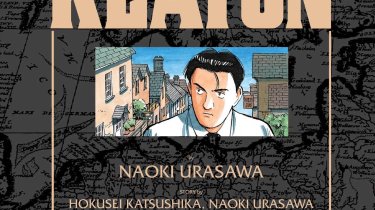
For manga, there’s only Naoki Urasawa’s 20th Century Boys Volume 16 (Viz, $12.99), but it’s not the best starting point if you aren’t already reading the twisty time-travel tale. So it seems to be something of a light week, but that’s ok, because I still have Baltimore purchases to enjoy. Being a comic fan doesn’t have to revolve around the weekly Wednesday.
20th Century Boys Book 16
- Posted by Johanna on August 23, 2011 at 1:28 pm
- Category: Manga Reviews
- CREDITS: by Naoki Urasawa; adapted by Akemi Wegmuller
- PUBLISHER: Viz; $12.99 US
The last few pages of Book 15 caused quite the discussion amongst 20th Century Boys fans of my acquaintance, as it showed the return of a character whose unseen presence lay under the entire middle section of the series so far.
Book 16 thus feels like a tease, since it doesn’t follow up on that brief appearance. There’s also more playfulness in its structure, incorporating the reader in its games. The cover approach, in which the kids seem to be talking directly to the viewer, continues on through most of the first chapter, which puts the reader in the story, taking a significant character’s point of view.
That character is the Friend as a child, finally showing us how he felt about always being on the outside of Kenji’s gang of friends. His wounded viewpoint consists of feeling smarter than the others but also keenly aware of how he’s left out of their plots. He may find what they do silly (or he may just be telling himself that to soothe the wound), but he still wants to be part of it, to belong. As kids, they’re selfish and thoughtless, unaware of how mean they’re being. It’s all complicated by his self-centered assumptions and willingness to be offended.
This chapter, even without remembering all the details of the bigger plot, is a wonderfully painful character study of being the outsider. I hadn’t thought of how the Friend came to be who he was from this internal focus previously. In many ways, he’s too much a cartoon super-villain for that, but Naoki Urasawa drags us inside his head, showing how the smallest action as a kid can have long-standing, unexpected influence later in life. After all, that’s the theme of the book, so it makes sense that that principle applies to all the characters, not just the “good” ones.
Still, even early on, this kid is manipulative and annoying. He’s focused only on what he wants and how others think of him, learning the power of information dropped in the right ear and the effect of playing on others’ beliefs. The previous scenes in the “haunted” house are revisited and elaborated upon to show more of his motivation, especially revealing how what matters to him is of no importance to anyone else. He seems to easily become obsessed, even to the point of it being considered mental illness. That may have been something the reader could figure out from previous events, but here, it’s both spookier and sadder, seen in a child who’s so mixed up about what should be important.
Urasawa’s staging is, as always, masterful, but it’s the characters’ expressions that really draw in the reader. I was marveling at how well he retells a classic story of a lonely child outsider, layered with creepy reminders of pieces of the tale we already know (including scenes of how the Friend’s coterie of assistants came together) … and just when it was getting really powerful, there’s a cliffhanger, and Urasawa flips us back to the future from the half-book flashback. Darn him!
Now, we’re in the post-plague world, where places have been quarantined and the near-superhuman Otcho is the only character we know. There’s yet more foreboding of doom, and perhaps one more chance to defeat the Friend and the world he’s built. It’s at these times, where the story leaps ahead once again, that my intellect thinks, “That’s a cheap trick to build suspense, cutting away and leaving yourself a gap where you can say anything happened.” Yet I’m still reading it, and I still want to see good win out in the end. Plus, Urasawa’s gorgeous scenes of rubble-filled village streets are cinematic in their appeal and detail.
20th Century Boys reminds me, in a way, of the Indiana Jones movies. They’re both a creator’s homage to the pulp entertainment they loved, and they’re both most enjoyable if you experience more than think about them. Because, in this case, the brain is going to point out just how much of a tease it all is, while the heart is hoping for Kenji to return once again, or for at least his spirit to live on.
(The publisher provided a review copy.)
20th Century Boys Book 15
- Posted by Johanna on June 27, 2011 at 7:48 am
- Category: Manga Reviews
- CREDITS: by Naoki Urasawa; adapted by Akemi Wegmuller
- PUBLISHER: Viz; $12.99 US
It stunned me to see that Naoki Urasawa, in volume 15 of his long-running series, was still introducing new characters, but it was so skillfully done, and the new cast member has such potential, that I was intrigued.
Since the conflict this time revolves around the Pope’s upcoming visit to Japan for the Friend’s funeral, it’s natural that the new character is a priest, Brother Luciano. He’s come to the home of his deceased mentor to carry on his work investigating an odd Book of Prophecy. The mentor previously rescued him from life as a gangster and a drunk, creating deep bonds that provide clues as to what actually happened to the older priest. The story of redemption would, in other hands, be trite, but here, it’s told efficiently, with just the right particular images to illustrate Luciano’s past and possible future. He serves as an object lesson that a little knowledge quickly becomes dangerous for the bearer in these circumstances.
I’m of the right generation that a plot to kill a Pope invariably reminds me of Foul Play, but it’s refreshing to see established religion finally make an appearance in 20th Century Boys. The cult that the Friend has formed would normally come in conflict with an established Church, but here Urasawa shows us how the Friends have superseded conventional religion to become a world-wide super-organization. This alternate take on the looming threat serves as a refreshing break from the heavy main plotline while serving as a reminder and introduction to new ramifications of the overall situation. Plus, Urasawa turns the event in an unexpected direction that’s even more surprising than anything the reader could suspect.
We get to see the young detective Chocho again, a favorite character, as Luciano winds up in police custody in Japan. The threads of similarity between him and a previously seen supporting character reveal themselves in surprising ways. In between, there’s an exciting flashback sequence in which a priest tries to get medicine to a remote Chinese village during a rainstorm during the first plague. Urasawa is sure to keep the visuals involving, even while filling in background and reminding us that even the Pope has his own past.
In each recent volume of 20th Century Boys, Urasawa has been surprising me with the direction he takes the ever-growing story. The overreaching structure isn’t forgotten, but by diving into individual stories and the changing facets of how this world affects individual inhabitants, Urasawa justifies his length and structure. Plus, it lets him draw plenty of dramatic reactions and cinematic sequences of suspense that are a pleasure to read and look at multiple times. (The publisher provided a review copy.)
Good Comics Out June 22
- Posted by Johanna on June 22, 2011 at 12:00 pm
- Category: Shopping Guide
It’s a long time yet to be thinking about autumn and Halloween, but I know my most-anticipated book this week, the Scary Godmother Comic Book Stories collection (Dark Horse, $24.99) will make a wonderful companion to last year’s Scary Godmother storybook collection. I have all the comics already, but they’re so much easier to reread conveniently this way. Plus, there’s a new color sketchbook section — and what a deal, for 300 pages of great reading at that price!
The new edition of Dreamland Japan: Writings on Modern Manga (Stone Bridge Press, $29.95) celebrates the 15th anniversary of its release. The industry has changed a lot since then, and a new forward and afterward put that gap into context. A book by Frederik Schodt is always worth reading.
In the “let’s point and laugh” category, Ziggy celebrates middle age with the hardcover Ziggy 40 Years 1971-2011 (Andrews McMeel, $24.99). Would probably make a great gift for your grandfather.
Also of some notoriety is the paperback version of Troublemaker (Dark Horse, $16.99), the Janet Evanovich series installment previously published as two hardcovers. Now that the whole story is under one cover at a reasonable price point, it’s a much better buy, but I suspect the unhappy novel readers may not return.
Most disturbing, though, is seeing six more Tokyopop books show up this week, two months after the company announced it was stopping publishing. Only one, Hanako and the Terror of Allegory Volume 4, is a conclusion; most head-scratching are the two debuts, Ghostface Volume 1 and Maid Shokun Volume 1. Zombie books walking!
On the positive manga side, I’m looking forward to another thrilling installment of Naoki Urasawa’s 20th Century Boys with Volume 15 (Viz, $12.99).
20th Century Boys Book 14
- Posted by Johanna on April 23, 2011 at 6:02 pm
- Category: Manga Reviews
- CREDITS: by Naoki Urasawa; adapted by Akemi Wegmuller
- PUBLISHER: Viz; $12.99 US
Ed’s glowing comments on the two previous volumes got me excited about reading this series again, especially after the soft reboot that happens in Book 13. (Warning: there are spoilers here for previous volumes.)
The big bad (who turned out to be a big bust) of the first half (Books 1-12) of the series is gone, but there’s still a global threat for the plucky gang of vigilantes to challenge. While the Friend was globablly beloved before, now, he’s a martyr. As the world mourns, those who remember and revere Kenji are gathering to break into Friend Land to find out more about what really happened to the kids back in 1971.
On a personal note, I’m glad to see more adult female characters introduced at this point. In addition to Kanna’s mother Kiriko (from the last book), who also holds the key to stopping the spread of a killer virus (making her defined by more than just her relationship status as mother and Kenji’s sister), there’s Takasu, a player on the other side. Takasu intrigues me because she’s such a schemer and realist. Her loyalties are not to a particular creed, only to herself, and her pessimistic realism is a refreshing contrast to the “no matter the odds against us, we’ll keep trying” determination of Kenji’s gang. She’s a manipulator, and perhaps I like her because she’s a more usual type of villain than the Friend’s bizarre certainties. The leadership void has been filled by someone unqualified; he’s not strong enough to take the position, but with her pushing him, no one else might see that.
The series seems to have gained new energy with the new, more deadly threat posed by the Friend’s organization, even though it’s not mentioned in this volume. Instead, the characters take a huge detour into the past. However, because of the virtual reality gimmick Naoki Urasawa is using, that history can be (and is) different than the one we’ve seen before. This time around, the kids are distracted, spending time with pinball machines or personal radios instead of their friends. They’re growing apart from each other, setting in motion the separation bridged only years later by Kenji’s desperate mission. We also get more background on other key players, people outside their group, and find out what Donkey saw in the science lab … maybe.
The art remains as cinematic as always, contributing to the perpetual suspense that’s a hallmark of this series. Urasawa never tells you anything directly when he can spin it across chapters, keeping you turning pages faster and faster in a quest to find the answers to the many mysteries he’s set up. Even what you think you know might be wrong, as the characters rewrite their own memories. All I know is, I’m back on board again. (The publisher provided a review copy.)
20th Century Boys Books 12 & 13
- Posted by Ed Sizemore on April 9, 2011 at 4:55 pm
- Category: Manga Reviews
- CREDITS: by Naoki Urasawa; adapted by Akemi Wegmuller
- PUBLISHER: Viz; $12.99 US
Review by Ed Sizemore
Otcho and the Kenji Group have pieced together all the clues, and finally, the moment to reveal the Friend’s true identity has come. However, it turns out that knowing the Friend’s identity doesn’t offer any advantage in stopping the New Book of Prophecy. Now the Kenji Group has to refocus its efforts on stopping a plot that looks to repeat the events of Bloody New Year’s Eve on a global scale.
Volume 12 marks the end to the first half of 20th Century Boys. You could call this story arc “Who Is Our Friend?” The hope was that knowing who the Friend was would give Kenji’s group insight on how to stop him and what he’s planning. But Urasawa loves red herrings and misdirection, so we instead discover that what’s important is not the man, but the plans he has set in motion. The New Book of Prophecy has a life of its own.
Volume 13 begins what I call “Stopping the New Book of Prophecy”. The start of this story arc really began when Kiriko, Kana’s mother, was introduced into the narrative. Of course, as readers, we didn’t know Urasawa was laying the foundation for a new story arc. Kiriko and the New Book of Prophecy just seem like new elements in discovering the Friend’s identity. Naturally, we should be wary of thinking we have the handle on the story. Urasawa is sure to have many more surprises in store for us.
Unlike Johanna, I enjoy reading the series in large chunks. I find the three-month wait between volumes is nerve-wracking. I like being completely lost in the world Urasawa has created and having all the details fresh in my mind as I move from volume to volume. You can see how the various timelines play off each other, how seemingly random events have deeper meaning, and how there are no minor players in this series.
A big appeal of the series is the human dynamics. I’m very fond of Yoshitune and his reluctant leadership. It’s an amazing lesson in the less flamboyant styles of leadership. Yoshitune, like so many of us, confuses charisma with leadership. Yoshitune may not be able to emotionally excite people like Kenji did, but he is doing the same work. The true core of leadership is the hard daily grind of keeping people organized and focused. For the past 14 years, he’s made sure people were cared for while continuing the investigation into the Friends Group. He doesn’t give himself enough credit as a vital member of the Kenji Group.
Kana’s idol worship of Kenji doesn’t help. Kana doesn’t realize that it took people like Yukiji to force Kenji to live up to his potential. Kenji became a great leader because of the support of his friends. It’s easy to believe that great leaders simply rise up from amongst the crowd by their own determination and special abilities. Urasawa reminds us that great leaders are born in and raised up by a network of support. Even the mighty Otcho didn’t simply appear out of thin air but was shaped by the people around him and his experiences with them.
These three-dimensional characters make the plot so exciting. We come to know and care about these people. We can identify with them directly or have friends that are just like them. This sympathy draws us into the story, because there are only a few extra-ordinary people in 20th Century Boys. Kana, the Friend, and even Otcho are the exceptions. This is really a celebration of the everyday hero. People like Yoshitune and Yukiji spend years fighting the good fight, slowly making progress against seemly impossible odds. Watching people just like us make a difference is both encouraging and a call to action.
Urasawa’s art is awe-inspiring. Flipping through the books, you can see the wide range of emotions expressed. His realistic art style blends perfectly with the realistic characters he creates. He’s reached that level of mastery where you don’t think about the art, yet it’s as integral to the story as the plot or characters. He uses page layouts to either speed up your reading and heighten dramatic tension or slow the pace down and really drive home what a character is saying or experiencing. I honesty can’t imagine 20th Century Boys being as compelling a read if it was just straight prose.
I always hate being caught up on 20th Century Boys. Urasawa has created such a rich world with fascinating people that I hate to have to leave it and wait three more months. Every comic book fan should be reading this series. It’s an exemplar of the best in graphic storytelling, a series as densely plotted as the best novels with visuals as stunning as the best movies. At the halfway point, I’m still as excited as when I picked up the first volume. This is a series I can’t wait to re-read like I did once Pluto was finished.
20th Century Boys Books 8-11
- Posted by Johanna on April 3, 2011 at 8:35 pm
- Category: Manga Reviews
- CREDITS: by Naoki Urasawa; adapted by Akemi Wegmuller
- PUBLISHER: Viz; $12.99 US
After reviewing 20th Century Boys Book 7 last year, being somewhat ambivalent towards it, and considering the overall series length of 24 books, I found myself putting the manga on personal hiatus. I stopped reading it for a while, since it was easier to keep up with shorter, cheaper, lighter weight books. But then Ed said he’d caught up, and he praised books 12 and 13 (which he’ll be reviewing here soon), so I thought I’d better read the in-between volumes as well.
I’m not sure I’d recommend that method, of reading a bunch in one big gulp. Unlike some of Naoki Urasawa’s other works, the serialized original publication method seems more obvious to me in this series. There’s only so many times I can be teased with “you’re the Friend!” and not be shown the face without feeling cheated, and that repetition only becomes more aggravating when it’s more frequent. My sense of patience has been tried greatly, both with key elements not being revealed and characters I enjoyed disappearing in favor of new, sometimes more generic ones.
Don’t get me wrong, this is excellent work — but it may be one of those items that I would be happier following serially. For comparison, many of my favorite TV shows I buy on DVD because I want to rewatch them and find new things in them, but there are a handful (like Bones) that I only need to see once. I enjoy watching them, but once I’ve seen them, I feel as though I never need to see them again. Similarly, I’m not getting a sense from this series that I will see new insight upon rereading. Sure, at the end, once all the mysteries are revealed (assuming they are — and that I’m questioning that isn’t a good sign), the early books will likely seem a little different, but realistically, how likely am I to reread four year’s worth of manga? (That’s assuming it keeps its bimonthly schedule.)
It’s a difficult question, and it’s probably a good idea that Viz released Pluto and Monster first, to build a reputation for Urasawa in the U.S. that gives readers more faith that the payoff will be worth it. And I did enjoy what I read. Contradicting what I said above, I buzzed through these four books, indulging in the adrenaline-fueled ups and downs, chases and threats. To continue the TV comparisons, I was never a fan of such serialized mysteries as Heroes or Lost. Maybe the qualities you need to follow those kinds of shows are needed here, too, the desire to puzzle out connections and hints and see if your guesses play out.
Book 8 begins with a lot of flashback about the actual construction of the robot that destroyed Tokyo on New Year’s Eve 2000. Of all the elements of that terrible turn of the millenium, that was one I wasn’t curious about at all. We do get to see Kenji be heroic, although we already knew he had been, and see eight pages of him singing a song that demonstrates how tricky it is to capture the emotional impact of music on the printed comic page.
The high point of the book is the expansion of Koizumi’s arc. Introduced in the previous volume, she is the high school student who’s investigating the history of Bloody New Year’s Eve and thus hearing the “real version” from the rich homeless man. Now, she’s not an original character — she was the typical rebellious-but-not-too-much schoolgirl in the last book, and she only becomes something more when she is very scared and threatened here. In a way, she’s the same as Kanna, Kenji’s niece and the spunky young fighter of previous books, only Koizumi is a more civilized, suburban version.
Koizumi is sent off to “Friend Land”, a brainwashing retreat introducing yet another set of characters. Book 8 is her story, really, as she struggles to survive, then overcome, until finally she’s sent back in time virtually to show us more of the kids back in the 70s, this time in a haunted house story. That continues in Book 9, which also introduces new extraordinary abilities for Kanna and a conspiracy straight out of Foul Play.
Between her psychic powers and the sudden introduction of a second book of prophecy, I found myself wondering if Urasawa was taking shortcuts at the last minute or plotting based on dice throws. Given the shifts in cast and the from-nowhere introduction of some of these concepts, the only way I can make sense of all this is to figure that the creator is working out some kind of bet, where he’s demonstrating that he can include every manga genre in this series — crime drama, conspiracy adventure, schoolgirl in danger, heroic rogue cop, young messiah discovering her purpose, even super fighters.
Book 10 finally brings the two young ladies together as Koizumi continues experiencing fallout from her experiences in Friend Land and is threatened with going to Friend World, with bigger and more extensive psychological manipulation. There’s yet another red herring Friend introduced, although his backstory makes for a touching side story about what it means to be a lonely little boy. By Book 11, his story is concluded, but that volume introduces Kanna’s search for her missing mother and a whole ‘nother level of conspiracy.
I admire the imagination involved in constantly spiraling more events into this book, but goodness, at the end, it’s a bit wearying! Still, all that said, I look forward to seeing Ed’s more in-depth thoughts on the next books, because I’m sure he has a greater appreciation for them than I do. I’m told Book 12 marks the turning point, with the volumes after taking a new direction. Just what this series needs — yet another change!
Are You Willing to Commit to Long Series?
- Posted by Johanna on February 16, 2011 at 8:25 am
- Category: Manga News
Kate Dacey asks a question I find myself very much in sympathy with:
do I really want to spend my money on a series that spans 10, 20, or even 40 volumes if there might be a shorter, snazzier title waiting in the wings?
These days, I find myself losing interest even in series I’ve been enjoying around book six or eight. In the past, I collected longer series. Checking my database, I see that I loved Tramps Like Us through all of its 14 books, and Maison Ikkoku went 15 (although a few of those I thought were repetitive), and I still have Sensual Phrase‘s 18 books. I have hopes for Nana continuing beyond book 21, once the author feels better, and I can’t wait for Hikaru no Go to complete in May with the next book, volume 23 (but that became almost a different series around book 14).
I would adore to see book 18 and more in The Kindaichi Case Files, but that’s not very serialized; almost any volume can be read in any order. Inubaka: Crazy for Dogs has made it to 17, and that’s similarly episodic, plus: puppies! I hope to see more of that series, although since Book 18 has no release date, that’s not a good sign. But Sgt. Frog I dropped a long while back (and I don’t even know how many books that’s going to be — it’s over 20 now). I’d forgotten about Tuxedo Gin‘s 15 volumes, but cute penguins apparently were enough for me back then (and it was a series both KC and I liked).
I still mean to reread all 18 entries in Naoki Urasawa’s Monster in order. Now that some of them are out of print, I won’t part with it, which brings up another point — it’s difficult for publishers to keep some of these longer series in print, so even if someone wants to start, getting all the volumes can be difficult.
Kate goes on to ask her readers’ opinions on four current long series she’s started. I’d do the same, but the only long series I’m reading right now is 20th Century Boys. I’ve read through 7, own through 12, and have decided to stop buying until I get caught up and decide if I want to continue. (I’m pretty sure I will — it’s good stuff.)
What lengthy series have you found worthwhile, or which would you recommend to readers?